Brigid Titgemeier Interview: Your “Normal” Labs Are Lying to You
Dear Media
You eat well, exercise, and hit your protein and fiber macros most days. You take supplements. And yet you still feel tired and foggy and bloated and puffy and irritable. But then you go in for lab work, and everything comes back “normal.” Sound familiar? Well, you’re not alone, and there’s a good reason for that!
In this podcast episode of Well with Arielle Lorre, host Arielle Lorre spoke with functional medicine dietitian Brigid Titgemeier about:
- Why your “normal” labs may not be so normal
- The 5 blood tests Brigid wants you to ask for
- The surprising link between insulin resistance, inflammation, and perimenopause
- Easy changes that have outsized impacts
This is for informational purposes only and isn’t medical advice. Please consult with a medical professional before making any changes to your diet, supplements, or lab work. The lab ranges and protein, carb, and fiber numbers below are Brigid’s recommendations, not universal rules. Her optimal ranges may be different than what’s considered “normal” by a lab.
Consider this your cheat sheet to the conversation. Want the full thing? Check out the full Brigid Titgemeier interview on Well with Arielle Lorre.
Listen while you read along; it’s worth it.
The Brigid Titgemeier Interview With Arielle Lorre That Will Have You Questioning Your Labs
Brigid Titgemeier is a functional medicine dietitian with 12 years of experience. She started at the Cleveland Clinic Center for Functional Medicine in 2014, working under Dr. Mark Hyman and reviewing thousands of tests.
Brigid later launched a graduate course in integrative and functional nutrition at the Case Western Reserve University School of Medicine. It teaches other practitioners. She’s also the founder of BeingBrigid and the host of The Being Brigid Show podcast.
In other words, she’s seen more lab panels than most of us will in a lifetime. If you can only do five things from this episode, make it these:
- Get the right labs. The standard panel can miss important tests that show changes happening in the body.
- Don’t wait for the labs. Your symptoms will tell you something is going on before the labs do.
- Eat enough. Counterintuitively, undereating can have a huge impact.
- Think beyond protein and fiber. They’re important, but they’re not the be-all and end-all!
- Consistency is key. Focus on it rather than perfection.

The 5 Blood Tests To Ask For
A lot of us hear our blood work is normal, so Brigid walked Arielle through the blood tests to ask for. That includes the ones a basic panel often misses.
Here are the five, in her order.
Fasting Glucose
Most doctors already run this one. The catch, per Brigid, is the interpretation. An optimal range may be closer to 70-85. But at 100 or 105, your doctor may still say it looks fine.
Hemoglobin A1C
Second on her list is hemoglobin A1C, aka your three-month blood sugar average. It gives a longer view than a single fasting number.
Fasting Insulin
Fasting insulin is the one that’s most commonly overlooked, per Brigid. Insulin resistance can develop 5-10 years before there are any changes in glucose.
So a lot of women are walking around insulin resistant, thinking, “I don’t have diabetes. I don’t eat McDonald’s. That must not be me.” But you can be insulin resistant even if you’re hitting the gym and sipping on smoothies.
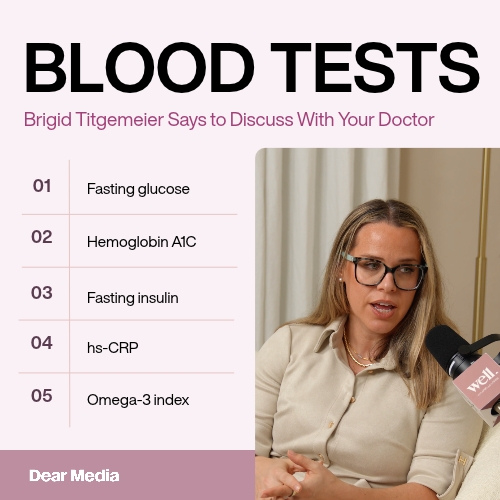
HS-CRP
This is your high-sensitivity C-reactive protein. Brigid calls it one of the most important markers for spotting overall chronic inflammation. Optimal would be less than one.
It’s almost a yes/no marker. But if there is chronic inflammation, you want to know!
Omega-3 Index
When Brigid asks a room of 500 people who knows their omega-3 levels, only about two hands go up. She recommends an omega-3 index of 8-12% (this would factor in omega-3s from food as well as supplements). This helps assess if you’re getting enough omegas to help decrease inflammation.
Bring this list to your next appointment. Ask specifically about fasting insulin and an omega-3 index, since those are the two most likely to be left off.
Signs of Insulin Resistance Before It Shows Up in Your Labs
Turns out, there are signs of insulin resistance you may already be experiencing. Brigid says “symptoms always precede lab changes,” and the research backs that up. So take what you feel seriously, even with normal labs.
Can you guess some of them? Here are the four she sees most often:
- Fatigue and energy slumps or crashes (i.e., not having consistent energy throughout the day)
- Brain fog, or trouble thinking clearly
- Mood swings, anxiety, or irritability (Brigid mentioned lashing out at your kids)
- Cravings and hunger
If two or three of these sound like your Tuesday, ask for the fuller lab panel above.
How Insulin Resistance Connects to Perimenopause and Belly Fat
In this part of the Brigid Titgemeier interview, Arielle and Brigid get into perimenopause and insulin resistance. It can be so hard to tease apart all of the symptoms women experience in their 30s and 40s. It’s almost a running joke among Brigid’s team of nutritionists. Everyone wants to know, “Am I perimenopausal? Am I insulin resistant? Do I just have inflammation?”
There’s significant overlap physiologically between hormones, blood sugar, and inflammation. The more inflammation and insulin resistance happening under the radar, the worse the hormonal symptoms will be.
Brigid recently came across a study. Higher insulin predicted more menopause symptoms, like night sweats and hot flashes (even more than BMI did!). Addressing this can have significant downstream effects on symptoms.
Insulin resistance also increases as women go through menopause. That’s why women may notice they’re gaining weight (and specifically belly fat!) even though they’re eating the same way.
Belly fat is almost like an organ in and of itself. It releases inflammatory messengers into the body, and it can snowball from there. The silver lining? Plug just one or two “holes” (aka a few core mechanisms), and you can see improvements in so many areas.
Why Your Metabolic Health Affects Your Brain and Mood
Arielle asked about the link between metabolic health and your brain. For Brigid personally, it all comes back to the brain! She wants her brain to be as sharp as possible so she can stay focused and productive. Brigid referenced research showing increased risk for cognitive decline with a diet high in ultra-processed foods.
Mood can also take a hit with poor metabolic health, from anxiety to depression. Brigid mentioned a recent study on an anti-inflammatory diet and depression. The diet alone decreased clinically relevant depression symptoms by 8%. Pairing it with exercise and no alcohol decreased depressive symptoms by 21%.
Brigid also walked Arielle through other areas impacted by poor metabolic health and an inflammatory diet. Joint pain and period pain are two prominent signs of inflammation. Skin conditions like acne, psoriasis, and eczema can improve too, once people remove their triggers. There are so many areas you can hit. As Brigid puts it, “Why would you not do this?”
The Undereating Trap
Two of Brigid’s easiest levers are sleeping enough and avoiding the undereating trap. Surprised?! Brigid can’t tell you how many times she’s run across women who chronically undereat to stay as lean as possible. Most don’t realize all of the downstream effects it can have.
Undereating can increase cortisol, a catabolic hormone. That makes it harder to build muscle, and it can also break down the gut lining. It can actually increase fasting glucose, too. When you’re stressed from not eating enough, your liver releases stored glucose through a backend process.
Brigid advised the CGM company Levels and reviewed hundreds of women’s CGMs. Time and time again, women eating nutrient-dense whole foods had fasting glucose on the higher side. They simply weren’t eating enough!
If you’re doing everything “right” and asking, “Why is my metabolism tanked?” under-fueling may be the lever to pull.
Think Beyond Protein and Fiber
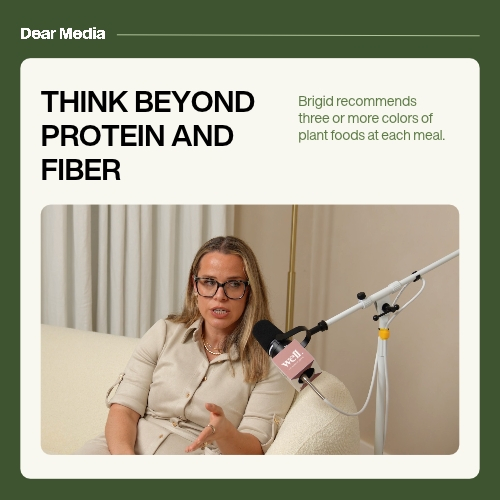
When it comes to macros, protein and fiber get all the attention. But Brigid wants you to go beyond protein and fiber.
First, the baselines. Brigid recommends at least 1.2-1.5 grams of protein per kilogram of body weight per day. She also recommends getting at least 30 grams of fiber a day from a variety of sources. But here’s where it gets even more colorful (pun intended)…
Brigid wants you asking, “Do I have three or more colors at this meal?” The colors signal a variety of phytochemicals (plant compounds). Those feed the good bacteria in your gut. These microbes then produce even more short-chain fatty acids, some of the most anti-inflammatory messengers in the body.
Protein and fiber are the floor. The color test is the easy upgrade you can do tonight.
Are Glucose Spikes Really That Bad?
So, are glucose spikes bad? Spoiler alert: the small ones are normal!
Glucose goes up when you eat carbs, even carbs found in things like onions and bell peppers. It should come back down to baseline within about two hours, day in and day out.
What we need to worry about are big 40-, 50-, or 60-point spikes happening multiple times a day, year after year. Every glucose spike also sends out inflammatory messengers, which accumulate over time. But a 20-point spike (remember everyone freaking out about these?) is “completely physiologically normal.” It’s what’s supposed to happen.
Then there’s why keto backfired for Brigid. During her keto phase in 2018 (when she was also running diabetes groups), she went very low carb. She avoided whole-food carbs like raspberries, sweet potatoes, and black beans.
As a normal-weight woman who was exercising and still cycling, Brigid experienced burnout and mild panic attacks in the afternoon. She also had poor sleep and central nervous system dysregulation. (If that sounds familiar, we share 12 ways to calm your nervous system that actually work.)
Eliminating these whole-food carbs can also decrease short-chain fatty acids. Over time, that can contribute to carb sensitivity and metabolic dysregulation, where one carb can spike your glucose by 80 points.
It’s about finding balance and building up metabolic flexibility, which is your ability to handle whatever you’re eating or drinking.
How Carbs and Protein Needs Change With Age
So, do your needs for carbs and protein as you age change? Short answer: yes.
For a woman who’s still cycling, Brigid recommends anywhere from 100-130 grams of carbs per day. You may need more if you’re breastfeeding, strength training five times a week, etc.
Women tend to become more carbohydrate intolerant as they get closer to and through menopause. Then that number sometimes drops down to 75-100 grams a day, depending on the woman.
Protein goes the other way. After age 50 (and even more so after 60), the risk of sarcopenia (muscle loss) speeds up. So Brigid recommends getting at least 1.5 grams of protein per kilogram of body weight.
Brigid Titgemeier’s Perfect Day of Eating
Brigid Titgemeier lays out her perfect day of eating as three meals and one snack, built on anti-inflammatory principles. (Disclaimer: it varies wildly based on the person.)
Breakfast
She rotates chia seed pudding, overnight oats, egg cups, or a smoothie. Her overnight oats use about a quarter cup of oats. Protein powder, nut butters, healthy fats, fiber, and chia seeds help offset the blood sugar bump oats can cause. For egg cups, she has three to four, roughly equivalent to three eggs.
She loves anything you can prep ahead, because preparation is such a big piece of consistency.
Lunch
Brigid is a big advocate of meal-sized smoothies for lunch, especially for people with afternoon cravings or slumps. The base is frozen cauliflower rice. A cup gives you a serving of cruciferous vegetables, which she says is great for hormone regulation and detoxification support.
Then she adds a form of fruit like frozen berries or cherries. A tablespoon or two of nut butter or chia seeds brings healthy fats and omega-3s. A protein powder rounds it out.
Snack
She’ll reach for dry roasted chickpeas mixed with pumpkin seeds or cashews, or apple slices with nut butter. Each one pairs a little carb and its whole fiber with protein and healthy fats.
Dinner
For dinner she likes make-ahead options like sheet pan meals. She also rotates a few recipes. Think chicken cacciatore with a lentil-based pasta, or an almond butter noodle salad over shirataki noodles with coleslaw, tofu, and edamame. There’s also a grass-fed burger bowl over lettuce, tomato, and onion, with a whole-food carb like quinoa on top.
The “What the Hell Effect” and Why 80/20 Works
Before Brigid explains the what-the-hell effect, a confession. Her favorite indulgences are dark chocolate and tortilla chips. She loves one brand cooked in beef tallow. She can’t keep it in the house because she’ll eat the whole bag. (Same, honestly.)
The what-the-hell effect goes like this. The diet starts Monday, then you have that doughnut, then the other one, and then the other thing. It can also look like eating one handful of chips, and then the whole bag. It’s that all-or-nothing trap we fall into.
Instead, Brigid recommends thinking of food in terms of 90/10 or 80/20.
The most important piece of nutrition advice Brigid can give? Consistency! Consistency is key with an anti-inflammatory, blood-sugar-balancing approach to food. As Brigid puts it, “You cannot supplement your way out of that.”
That includes those “healthy” options a lot of us grab on the go (protein bars, rice cakes with nut butter, etc.). What you remove matters. So does what you put back in, like micronutrients, phytonutrients, and polyphenols.
Foods That Seem Healthy but Can Spike Blood Sugar
These next ones might sting a little… From a blood sugar perspective, Brigid flags these foods disguised as healthy as potential spikers:
- acai bowls
- some smoothies
- overnight oats
- rice cakes
- vegan bowls (especially those with brown rice, black beans, and sweet potatoes, which can easily be 90 g of carbs)
Unless you’re very active and it’s post-workout, you likely don’t need this much in one sitting.
What To Test When You’re Eating Well and Still Feel Off
If an anti-inflammatory diet still leaves you foggy, puffy, or lethargic, Brigid has a next layer of testing when you still feel off. First, she may add in a few more conventional lab values, like ferritin. That makes sure those numbers are where they need to be.
Next, she heads functional with an organic acids test. It’s a urine test that looks for nutrient deficiencies across B vitamins, fat-soluble and water-soluble vitamins, vitamin C, magnesium, zinc, and more.
A cortisol test can also be helpful, but not the one that’s a one-time blood draw. This one is a saliva test you do six times throughout the day. That way, you see your trend for the whole day.
A functional stool test can also give you insight into your gut health by looking at your gut microbiome composition.
Brigid used to do a lot of food sensitivity testing. But over 12 years, she’s noticed that a lot of sensitivities stem from something going on in the gut. That needs to be addressed before you “create so many food fears” and eliminate more than necessary.
Talk to your doctor about which labs are right for you. Also keep in mind that some functional labs aren’t as established as conventional ones.
How Fast Can You See Results
So, how fast labs change depends on what you’re looking at. For clients dealing with insulin resistance, Brigid usually sees changes in numbers (like hs-CRP, for example) in around three months. Symptoms can start to improve in as little as seven days!
Brigid also points to research on the gut. It only takes three days of a diet change to start changing your gut microbiome.
Unfortunately, we lack patience. We tend to give up before we see the changes in labs that we’re hoping for. Along the way, we ignore the other positive changes (bowel movements! energy!) that can tell us we’re on the right track. Then we go back to our previous behaviors.
As for supplements, Brigid isn’t anti-supplement! She thinks most people can benefit from them, given our depleted soils. Stress also speeds up the loss of nutrients like B vitamins and magnesium. (For more on who actually benefits, check out our piece on whether you need a multivitamin, with Dr. Will Cole.)
However, supplements will only get you so far if you’re still eating protein bars for meals.
The One Food Brigid Says To Add Every Day
Asked for the one food to add every day for better metabolic health, Brigid’s answer is simple. Add beans! Aim for a cup per day. A half cup for breakfast and a half cup for dinner works too.
The exception is if you’re dealing with a ton of GI distress from an extreme leaky gut situation. Otherwise, “beans are such a powerhouse.” They’re rich in phytochemicals and offer 7 g of fiber per half cup.
Overrated or Underrated: Seed Oils, Dairy, Fasting, and More
Arielle wrapped up with a rapid-fire round of overrated or underrated, and Brigid’s seed oil answer was refreshingly honest. Brigid has recommended staying away from seed oils throughout her career and still does. But she admits the science doesn’t back up that they’re as inflammatory as we make them out to be. That said, she’s still not a fan because:
- they oxidize (especially when they’re sitting in that clear plastic bottle in the light!)
- eating a lot of seed oils likely raises your omega-6 to omega-3 ratio, one way they can promote inflammation
The rest of the round, in no particular order:
- creatine: underrated
- 10-minute walks after meals: underrated
- dessert: underrated (she’s a dessert advocate! There’s a place for some sugar on an occasional basis.)
- CGMs for healthy people: underrated
- dairy: underrated (as long as you tolerate it and it’s not promoting inflammation for you)
- Fasting for women over 40? Yes (as long as the intervals aren’t super long)
Brigid’s closing point? Take a break from data! She recommends a “holiday” from your CGM or wearable if you need it. Don’t let that sleep score sour your whole day. Try to approach data with as little emotion as possible.
Brigid pointed to those naturally wise 80-year-old women who’ve been doing yoga for years. They’re out eating with each other and building community, without cutting off their last bite at 6 p.m. As Brigid sees it, loneliness is a bigger driver of poor health outcomes than smoking. Arielle’s response? “Mic drop.”
TL;DR: Want labs? Ask about fasting insulin, hs-CRP, and an omega-3 index on top of the basics. Trust your symptoms, eat enough, aim for a cup of beans a day, and let 80/20 be your friend.
Follow Brigid on Instagram @beingbrigid, visit her website at beingbrigid.com, or check out her podcast, The Being Brigid Show.
Ready for more? Watch the full conversation with Brigid Titgemeier above. Then catch every episode on the Well with Arielle Lorre show page on Dear Media. The show is part of the Dear Media Network. It’s home to 100+ top-rated podcasts on pop culture, entertainment, lifestyle, and more, hosted by some of today’s most talked-about creators.
Editorial Stories
Trending Products


Leave a Comment
Suggested Articles

How To Build a Brand on Social Media: Lessons From Poppi’s Allison Ellsworth and Outdoor Voices’ Ty Haney
Nov 3, 2026 Career & Money
Khloé Kardashian and Scott Disick Dating Rumors: Khloé Finally Sets the Record Straight on Khloé in Wonder Land
Nov 2, 2026 Relationships



Leave a Reply