A Parenting Expert Just Said the Thing Every Exhausted Mom Needs to Hear in 2026
Maggie Ekberg
Here’s the thing nobody warns you about adulthood: at some point, life starts feeling like a game of Whack-A-Mole you can never actually win. You answer the email, another one appears. You finish the laundry, there’s more laundry. You schedule the appointment, now there’s a form to fill out. You finally sit down, and your brain immediately reminds you of every unfinished task since 2017.
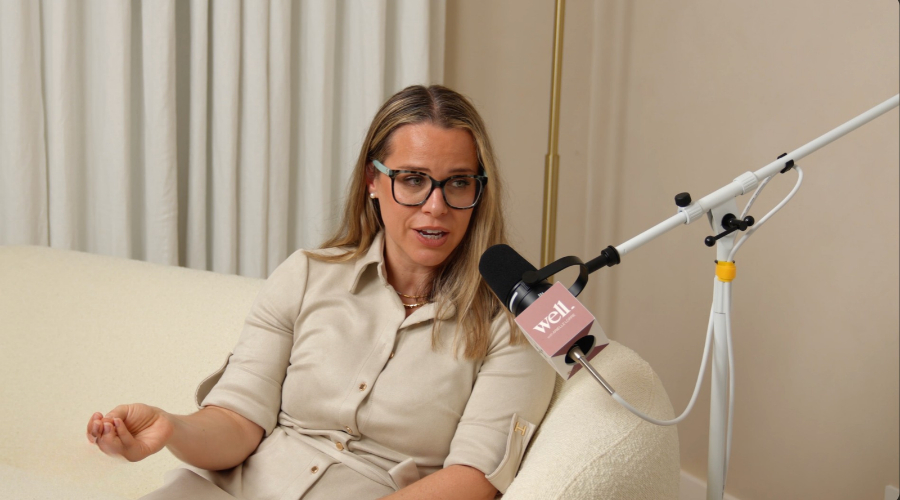
On After Bedtime with Big Little Feelings, Kristin Gallant explains why so many women feel exhausted and convinced they’re failing at life—even when they’re doing an unbelievable amount. Think of this as a reality check for every woman who’s ever looked around and thought, “How is everyone else doing this?”
Almost every woman feels behind at life
“98 percent of people feel like they are behind at life and that everybody else has it all together,” Gallant says, citing an Instagram poll she ran with around 80,000 women. Nearly every woman who answered believes she’s failing AND that the rest of us are crushing it. Meanwhile, every single one of us is “one Spirit Day school email away from moving to a farm on the top of a mountain and disappearing forever.”
Your brain is running 47 browser tabs at all times
Mothers carry over 70 percent more invisible mental load than fathers, which means even when you’re “resting,” your brain is sprinting through a to-do list. “Your nervous system is essentially running 47 browser tabs at all times, maybe more,” Gallant says. A non-exhaustive snapshot of those tabs:
- Did I sign up for that field trip
- Summer camps (she also hasn’t signed up)
- Buy the teacher gift
- Rotate the winter clothes
- Text that friend back
- Is her color actually green this Spirit Week
And it gets worse. Chronic mental load raises cortisol and tanks your working memory, which means you forget more things, then shame yourself for forgetting them. “Your brain literally becomes less efficient under chronic overload,” she says. The cycle is real, and it’s exhausting.
The sourdough mom and the marathon mom are different people
“We absolutely cannot run a marathon, be committed to making the perfect bento boxes, have a spotless kitchen, have a thriving marriage, get matching linen sets, have a perfectly organized playroom, make homemade sourdoughs,” Gallant says. “That doesn’t exist in one person. Those are a bunch of different people.”
Why does this matter so much? Because doomscrolling is doing real damage. According to Gallant, “social comparison and rejection activate many of the same brain regions associated with physical pain and threat detection, meaning your brain experiences inadequacy as danger.” Every Instagram session is your nervous system taking a literal hit.
Perfectionism gets wired into girls way too young
“Girls receive significantly more praise for being helpful, well-behaved, and ‘good’ compared to boys, while boys are often more praised for risk-taking, independence, and confidence,” Gallant explains. Fast forward 30 years and you’ve got grown women whose nervous systems “learned productivity equals safety, achievement equals love, being low maintenance equals belonging.”
Motherhood then becomes the ultimate perfectionism trap because the to-do list literally never ends. “The laundry replaces the laundry. The dishes replace the dishes. The emails replace the emails…the second you clear one thing, life generates 14 more things.”
Rest is preventative, not a reward
“Rest is preventative care for your nervous system,” Gallant says. “The recovery isn’t earned. The recovery is essential.” In other words, it’s not the thing you finally get to do once everything is handled. It’s the thing that keeps you from collapsing in the first place.
How many of us only stop when our bodies physically force us to? Migraines, panic attacks, autoimmune flares, full breakdowns. “My body eventually started screaming what my nervous system was telling me all along and that I was just pushing down,” Gallant says. The fix is small, intentional moments of recovery you build in instead of waiting for… like letting your partner handle bedtime so you can take a bath, asking grandma to come over, closing the laptop before the group chat pulls you back in. It doesn’t need to be a spa day.
‘This is enough for today’ can actually rewire your brain
Instead of ending the day with a mental list of everything you didn’t do, pause and consciously say out loud, “This is enough for today. I’m proud of myself.” After work. After bedtime. Before sleep.
“Neurons that fire together wire together,” Gallant says. The “I didn’t do enough” loop is a deep, well-worn groove in your brain. Every time you swap it for self-compassion, you’re carving a new one. Do it enough times, and the new one becomes your default.
Bonus: self-compassion actually lowers cortisol, boosts working memory, and improves long-term motivation. Self-criticism does the opposite. So talking to yourself like a friend is the most strategic move you can make.
Your kids already think you’re enough. You’re just the one fighting it.
After forgetting a school event, Gallant mumbled, “I’m such a mess” under her breath. Her daughter overheard and walked over: “You’re not a mess. You’re my mom. You’re the best mom.”
The realization that came with it is the part that wrecks you. “What if the people in my actual life that I care about, the people who live in my house, the people who are nearest to me, the ones who matter the most, by the way, my children, what if those people already think I’m enough? What if I’m the only one arguing with that?”
Kids are watching how we treat ourselves. They’re watching us apologize for existing, call ourselves lazy, panic-clean before guests come over, and treat exhaustion like a personality. Gallant doesn’t want her daughters growing up believing “womanhood and motherhood is just permanent exhaustion while pretending you’re fine.” A goal worth getting behind.
The women who seem free? They picked their things and let the rest go
Whether they’re stay-at-home moms of five or career-first powerhouses, the women Gallant admires all have one thing in common. “They fully realized and stuck to the things that felt the most important to them. They unapologetically put that thing or those few things first. They love that thing. They are lit up by that thing. They fully commit to that thing or those few things. And then they let the rest go. And they don’t feel bad about it.”
The shift is moving from “how do I do all of this perfectly” to “how do I actually want to live.” Two completely different questions, and only one of them is actually answerable.
“You are not behind,” Gallant says. “You’re carrying too much. And that’s very, very different.”
Listen to the full episode on After Bedtime with Big Little Feelings, available wherever you listen to podcasts.
Read Next
- Two Moms Break Down the Stranger Danger Rules That Actually Work in 2026
- What Postpartum Depression Really Looks Like—And Why So Many Moms Suffer in Silence
- 6 Picky Eater Hacks From Two Comedian Moms That Are Honestly Genius

Trending Products


Leave a Comment
Suggested Articles

Inside the Influencer Industry: Bran Flakezz Gets Real With Alexis Oakley About Money, Managers, and Burnout
Nov 9, 2026 Career & Money



Leave a Reply