How To Stick To A Routine: Simple Habits That Actually Last
Influencer
It’s no secret that in life, we all have some sort of routine, right? Like “Step Into Your Best Year Yet!‘ from Beyond the Mat discusses, we’re all just striving to find ways to set goals, keep motivation, and build a growth mindset. But here’s the thing: setting goals is the easy part. Sticking to them? That’s where it gets a little tricky.
B. Simone from Let’s Try This Again said it best: it’s important to have grace and discipline when it comes to, well, everything. You can’t bully yourself into growth. But… what if we could do it right the first time? What IF, hear us out, we could set routines and actually follow through for good? No “I’ll start Monday” or “I’ll attempt again tomorrow,” excuses—just tried and true habits that build change.
It’s totally possible, which is why we’re here to talk about it. Today, we’re sharing all of our BEST tips and tricks for sticking to a routine. We’ll explore how long the process takes, how good it can be for your mental health, and how YOU can set your self up for success. Ready to build and bloom? Let’s dive in.
How To Stick To A Routine: Simple Habits That Actually Last
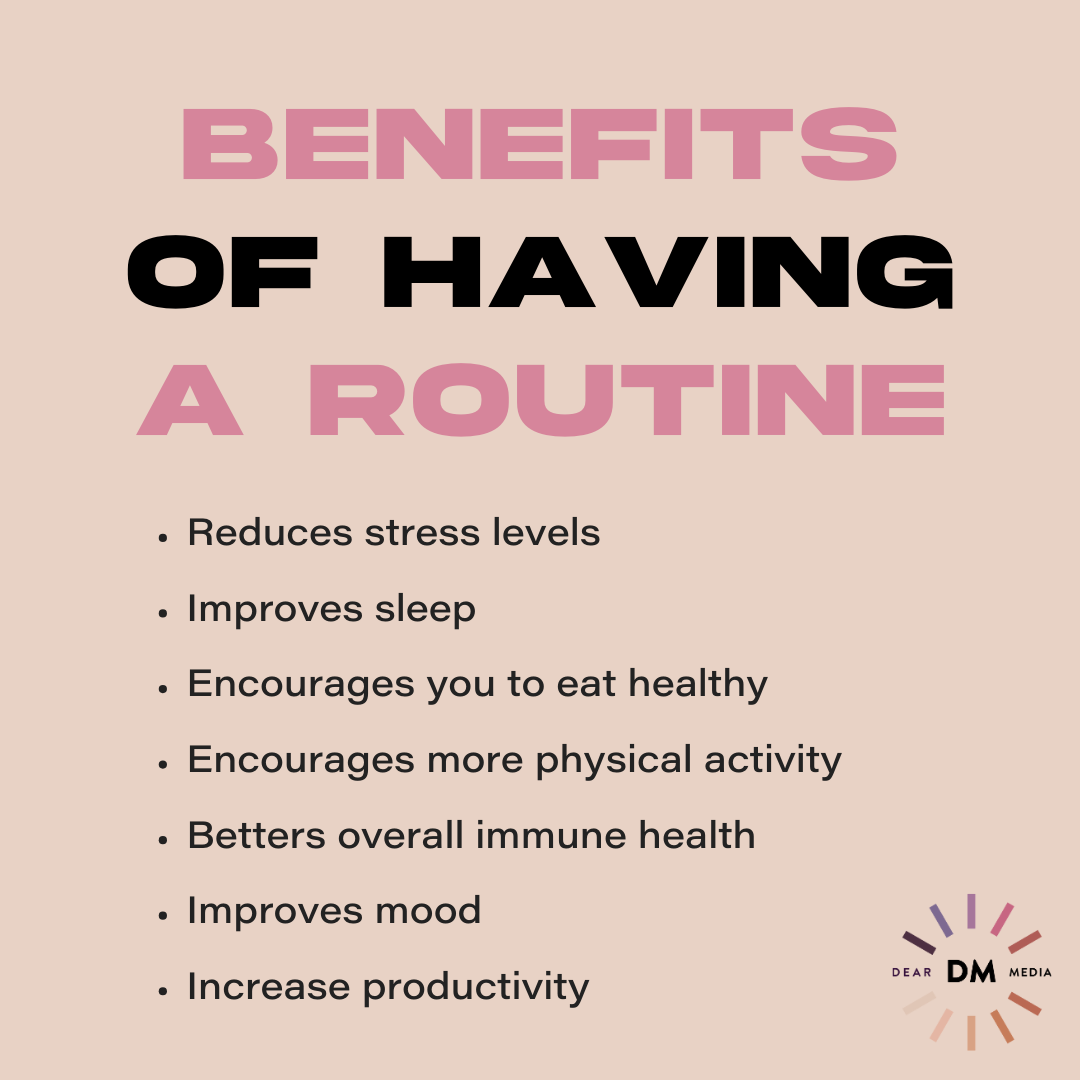
Benefits Of Having a Routine
First of all, we know that having a routine helps us stay on track. DUH! But what else is it good for? According to Michael Bosstick from Him & Her Show in THIS episode, it helps you establish a clear direction, setting high-impact goals that actually move the Needle. And according to “Jay Shetty on Relationships, Passion, and Finding Purpose in Your Life” from SHE MD, a routine can help with mindful living, meditation, and self-awareness.
We could go on and on, but you get the point. Sticking to a routine is essential no matter what you’re trying to achieve—or in what area of your life. Let’s get more specific, though. Here are a few research-backed health benefits:
- Reduces stress levels
- Improves sleep
- Encourages you to eat healthy
- Encourages more physical activity
- Betters overall immune health
- Improves mood
- Increase productivity
How Long to Make a Routine?
You’ve heard that cliché, the one that says it takes “21 days to form a habit.” Unfortunately, as much as we want that to be true? That old data was a little… off. According to research, it generally takes 66 days (or 10 weeks) to form a habit—AKA, a routine.
Because that’s all routines are at their core—are healthy, good-for-you habits that you actually WANT to stick to. And we get it… that sounds like a long-time. Routines aren’t for the weak, but they ARE for those who want real, noticeable change.
Is Routine Good for Mental Health?
Routines are SOOO good for your mental health. In fact, studies found that routines that supported a sense of stability basically act as a reliable pattern that we’re in control over. Think: better productivity, focus, self-esteem, self-care, and overall health. And in turn? Lower stress, anxiety, and uncertainty. (And, of course, less time being hard on yourself.) It’s basically a recipe for success.
But if it’s so good for you… why’s it so hard to stick to? 9 times out of 10, it’s that “all-or-nothing” mindset—which is exactly what Siff Haider, host of The Dream Bigger Podcast, talks about in THIS episode. The fear of failing and the ease of “doing it tomorrow.”
Those days are OOOVVERRRR. Let’s talk about how to stick to a daily routine—the right way(s).
How to Start a Routine
Consider this your “before you begin” section. First, we’ll talk about the mindset shifts, the why‘s, and the consistency of it all. THEN we’ll focus on how you can actually establish what you’ve put into place.
Anchor Habits to Existing Behaviors
It’s so much easier to link new habits to old ones. You already have SOME form of routine, right? Whether that’s making coffee in the morning, meditating after lunch, or reading before bed. When you tie in a new routine to an old one, it’s easier to, what we like to call, habit stack! You perform one activity and your new one will seamlessly follow.
Want more? Listen to THIS episode of With Whit. Host Whitney Port invites on Dr. Michelle Segar to talk all about the “habit paradigm” backed by science and decades of coaching. Trust us, it’s a goodie.
Create a Flexible Time Window
DITL‘s episode, “Make Small Improvements Each Day, Says Pilates Guru Emma Stallworthy,” is like textbook for this topic. As we’ll touch on later, it’s sooo important to be flexible with yourself, your progress, and your goals. When you give yourself TOO much structure, you create this loop of disappointment. And it’s not just you! This happens to everyone regardless of their goals.
Celebrate your progress, come as you are, and slip in your routine where you can. So long as you stay motivated and don’t give up? You’re golden.
Repeat Before You Refine
Before you even think about tweaking your routine, give it a shot first! SO many build a perfectly mapped-out, step-by-step process—then second-guess it as soon as it comes time to hit the ground running. They adjust timing, swap steps around, or scrap the whole thing before their brain has a chance to recognize the pattern.
Consistency. Is. KEY. You have to give it a chance before you give in to second-guesses. Otherwise, you’re not really giving yourself an opportunity to follow-through. Once you’ve “lived in” your routine, then you can change things around.
Listen to “Go One More: Nick Bare on Resilience, Routines, and Showing Up” from The Gabby Reece Show! This episode talks all about the importance of consistency habits and adaptability.
Figure Out Why You Want a Routine
You know how people always say “you can’t help someone who doesn’t want the help”? The same goes for routines. You can’t stick to something if you don’t truly want it. The outcome, the results, the progress—any of it.
Before even starting, figure out your why. Are you working out more because you want to lose weight? Or because you want to tone up? Are you investing in your health and wellness routine because you want to? Or because it’s a new year and you feel like you have to? Make sure to keep YOUR wants at the forefront—and never forget your why. This is where success blossoms and thrives.
How to Establish a Daily Routine
Decide what tasks are important to you.
The first step to establishing a good daily, nightly, or morning routine is to determine what tasks are most important to you. Consider both good habits you want to start and bad habits you want to stop. We forget about that second option a lot, but if you want to stop being on your phone in the evenings or stop buying coffee every day? Include it.
Make a list of all the daily habits you want to work on. You could even think about your overall goal! Do you want your routine to help specifically with mental health? Or, do you want your routine to optimize productivity? Decide this to help you narrow your focus and choose the best tasks for your routine.
Don’t forget to include self-care.
We have a tendency to include draining tasks on our routine list. These to-dos aren’t necessarily bad, but they take real effort and can totally zap your energy. Things like doing the dishes every day, taking the dog on walks, cutting caffeine, waking up earlier, and cooking home cooked meals is all great for you! However, these daily routine tasks involve a lot of effort, discipline, and punishment.
Your routine should make you feel good. It should reduce stress levels, better your sleep schedule, improve your mental health, and all the other health benefits listed above. In order for that to be possible, your routine needs to be good for your mind, body, and soul.
Consider adding self-care into your daily routine. These are easy boxes to check off that make you feel good and require little to no effort! Include things you love to do, like taking a bubble bath, listening to a podcast, drinking some tea, or even taking a nap! These tasks will be easy to accomplish and motivate you to complete all your daily habits. While you’re at it, we have a few extra tricks up our sleeves… Tune into: Sleep Secrets REVEALED: Dr. Shelby Harris on Women’s Insomnia and Are You Stressed, Overstimulated, or Always Scrolling? Reset Your Brain with Harvard Stress Expert Dr. Aditi Nerurkar
Remember it’s a routine, not a schedule.
Though doing things around the same time every day is a good idea, don’t make your routine too rigid. Setting exact times that you do each thing every day may work for some people, but if you’re struggling to stick to a routine? This could be one of the problems. Instead of demanding you stay on a set “schedule,” instead go for a routine.
What’s the difference? A routine is more of an order of events than a specific outline of your day. So, maybe you get up at 6:00 am one day, but 8:00 am another day. With a morning routine, both those days start with a workout, then move to breakfast, your go-to skincare routine, and some light reading. One day the routine might be 30 minutes long, and another day it’s a couple hours. No matter what, though, the routine happens!
Giving yourself this type of fluidity can help increase your chances of success! Because when things are too strict, you’ll get discouraged, throw up your hands, and give up the first day things don’t go as planned. Maybe you’ll try again tomorrow, maybe you won’t. So, try making a loose routine instead of a strict schedule!
Prepare your space.
Another reason people don’t stick to their routines is because their space isn’t built for it! Your routine should be easy to accomplish every day and involve as few extra steps as possible. (Seriously, sometimes expecting yourself to take something out of a drawer and put it away after use is too much.)
So, prepare your space by getting it ready for each of your tasks. That might mean setting up a yoga space in the corner of the living room where your mat and oil diffuser are always set up and ready to go. It might mean having a little basket with all your bullet journaling supplies right at your dining room table where you like to do your reflections. Or, it might just be getting organized!
The What We Said podcast hosts discuss this relationship between a clean and prepared space and the success of your daily routine in the episode “HOW TO CLEAN UP YOUR LIFE.” Take a listen, look at your tasks, and make your home work for you.
Make each task fun.
Healthy habits shouldn’t be a punishment—they shouldn’t feel negative at all. Even if getting up at 6:00 am isn’t your favorite thing or going without caffeine feels like the end of the world right now, you can make tasks fun by having a rewarding twist to each task.
For example, if you’re done drinking caffeine, maybe replace your coffee with a delicious smoothie. If getting up early is your new thing, and you’re not a fan, create a morning oasis for yourself with candles, music, and maybe a new comfy chair. Or, if cleaning is somewhere on your tasks lists, listen to your favorite playlist or binge a podcast while doing it. Don’t let your routine become a drag, enjoy it!
Also, everyone struggles with this—so don’t be hard on yourself. Just listen to “Miranda Kerr on Wellness & Beauty Rituals, Health Non-Negotiables, & How to Stay Present & Grounded.”
Start small and keep your expectations fluid.
When you make too big of a goal, you’re more likely to psych yourself out. Think of this in weight loss terms—it’s easiest here. Wanna lose 50 pounds? It’s gonna take a lot of time, dedication, and discipline. Non-stop. Want to start off with 5 pounds and go from there? You’re MUCH more likely to set your mind to it and stick with it.
This way, you’ll have more opportunities to celebrate your accomplishments and no task is too big! Just as importantly, though, is to loosen up your expectations. Remember what we said earlier: some days may look different! You have jobs, responsibilities, requirements, doctors appointments, dates, kids—the list goes on. Leave room for life outside of your routine, too.
Also! Listen to “HOW TO WIN 2026” from Transform! The Sami duo talks all about how huge goals, pressure, and bigger checklists can lead to burnout. And, don’t worry, they’ll also share tips on how to combat that.
Track your progress.
Making yourself a disciplined person isn’t easy, but tracking your progress is one of the best ways to create positive brain pathways that remind you that sticking to your goals is a good thing! Find a habit tracker app, planner, or dry-erase board to help you visualize your achievements.
The beauty is, once you unlock your discipline and understand what you find motivating, you unlock a whole new level of performance. You will become more productive and accomplish more with less support. You’ll know exactly what you’re capable of achieving on your own!
Give yourself rewards!
If we’ve learned anything from “Why Good Vibes Only Is RUINING Your Spiritual Growth,” from Dear Gabby, it’s that you can’t just keep chugging along regardless of the circumstances. You deserve to celebrate the progress as much as the result. Another great way of establishing healthy routines and gaining self discipline is through rewards. Everyone is motivated differently, but if you can set your eyes on some sort of prize, suddenly sticking with your routine feels a whole lot easier . . . and a whole lot more fun.
If you have financial habits you want to keep, maybe your reward is a vacation. If you have food goals, perhaps your reward is dinner at your favorite restaurant. Or, if you have workout goals, maybe your gift to yourself when you’ve worked out consistently is to buy a new outfit to flaunt your healthy bod. The choice is yours!
Find an accountability partner.
We all know creating a routine is one thing. It can be highly intentional, include lots of rewards, have lots of flexibility, and you can STILL struggle to stick to your new routine. One of the best things you can do to ensure you don’t give up, but carry on with your new daily habits is to get an accountability partner who gets you, gets your goals, and will push you like crazy.
Reevaluate your routine regularly.
Your routine may not be perfect. It probably won’t be the perfect fit for you right away. As your life changes and as you get to know yourself better, you’ll realize how to develop a routine that truly works for you.
But here’s another helpful tool to keep in your toolkit: “Build Better Habits in 4 Steps” from Almost Adulting. This episode is all about how to build better habits, reevaluate as things change, and stack the deck in your favor. Your routine aligns with you and your life—not the other way around.
Creating a routine is one thing, but sticking to it can be tough!
A routine can literally change your life. It can make you more productive, more fulfilled, and it can even improve your mental health. It’s time for you to establish a routine, stick to it, and see the transformation in your life that you totally deserve. Trust us—it may be tricky at first. But those long-term gains? Totally worth it.
For more self-help tips, check out our Dear Media blog and our catalog of stellar podcasts that can help you be the best version of yourself! And, of course, don’t forget to visit the DM shop, where you can find plenty of things to reward yourself with.


Trending Products


Leave a Comment
Suggested Articles



Leave a Reply